Whether you're a builder, installer, or designer, correct installation is essential to ensure safe and reliable performance. This guide walks you through key safety requirements, framing considerations, and step-by-step installation for your EcoSmart Fire appliance, helping you achieve a compliant, secure, and well-finished result.
Important Safety & Installation Requirements
These appliances must be installed into a fixed secure position before being operated.
NOTICE: DO NOT INSTALL DIRECTLY BESIDE OR NEAR WALLPAPER, LAMINATE, VENEER OR ANY SURFACE THAT IS NOT DESIGNED TO WITHSTAND HEAT AND HIGH TEMPERATURES (the heat will impact the material, and in some circumstances the glue used for its application). THE AREA AROUND THE Appliance GETS HOT. HEAT SENSITIVE/REACTIVE MATERIALS SHOULD NOT BE USED. DO NOT PLACE FLAMMABLE OBJECTS ON OR AROUND THE APPARATUS.
These appliances are not designed to incorporate doors or opening covers.
The appliance must remain open at all times for ventilation – it is not designed to operate as an oven or similar "hot box" – the flame must have a constant supply of air to operate and be able to circulate and distribute the heat effectively
DO NOT PACK REQUIRED AIR SPACES (the space between the appliance and the spacer ) WITH INSULATION OR OTHER MATERIALS. The air spacers are needed to ensure proper temperatures are maintained behind the appliance.
Do not modify the appliance in any way during installation. Cutting of sheet metal parts of the appliance is prohibited.
Expansion and contraction of internal parts due to heating and cooling off may create noise. This is normal.
WARNING: DO NOT OPERATE WITHOUT THE GLASS WINDSCREEN
The appliance must be fully assembled before being operated. Failure to install (or removal of) glass panels will void the warranty and render the product unapproved for use with the included burner.
Framing
Important Considerations for Framing
1. The appliance must be installed on a level surface capable of supporting the appliance, burner, glass charcoal and full fuel capacity.
2. The framing dimensions shown in the instructions are the optimum dimensions that allow best fit with gyprock / sheetrock / plasterboard (or other facing/finishing material) after the appliance has been installed.
3. Prepare the installation location. If placing the appliance on a platform, build the platform, making sure to accommodate the weight of the appliance, burner, glass charcoal and fuel. Verify that the platform is level.
In the case of insufficient capacity to hold the weight of the appliance, measures must be taken to reinforce the setting (for example installation of a plate for load distribution) so that the setting is suitable for installation.
IMPORTANT: The framing above the appliance must be self-supporting. The appliance is not load-bearing.
Definitions
Combustible materials - Materials made of or surfaced with wood, compressed paper, plant fibers, plastics, or other material that can ignite and burn, whether flame produced or not, or plastered or un-plastered shall be considered combustible materials.
Non-combustible materials - materials which will not ignite and burn. Such materials are those consisting entirely of steel, iron, brick, tile, concrete, slate, glass or plasters, or any combination thereof. HardieBacker®, WonderBoard®, Durock® or materials that are reported as passing ASTM E 136, Standard Test Method for Behavior of Materials in a Vertical Tube Furnace at 750C shall be considered non-combustible materials.
NOTE: Illustrations reflect typical installations and are for DESIGN PURPOSES ONLY. Illustrations/diagrams are not drawn to scale. Actual installation may vary due to individual design preferences.
Before getting started
- Carefully remove the appliance and components from the packaging
- Inspect and report any parts damaged in shipment, particularly the condition of the glass windscreen.
- Read all of the instructions before starting the installation. Follow these instructions carefully during the installation to ensure maximum safety and benefit.
WARNING: Risk of fire or explosion! Damaged parts could impair safe operation. Do not install damaged, incomplete or substitute components.
Installation
Equipment required: Power Drill, Screwdriver, Level, Hand Trowel for Plaster, Silicone Gun, Caulk Gun
1. Construct the main wall framework with the opening size shown in Table A. The base of the frame can be a solid bench/platform, which will assist in leveling up the appliance when in position.
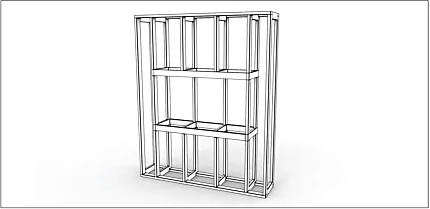
Optional built-in styles shown below. Please make sure the bottom of the firebox is fully supported by framing if you install the appliance partially recessed or flush with the wall.

Table A: Framework Opening Sizes
Physical appliance dimensions should be verified against cut out dimensions BEFORE
installation begins to confirm tolerances align.
| Appliance | WidthWidth | Min. DepthMin. Depth | Height Height | Weight*Weight* |
| Heritage 26SS | 775 [30.0] | 585 [23.0] | 775 [30.5] | 45 [99.0] |
| Heritage 42SS | 1,170 [46.0] | 585 [23.0] | 930 [36.5] | 57.4 [126.3] |
| Heritage 56SS | 1,525 [60.0] | 585 [23.0] | 1,145 [45.0] | 84.3 [185.5] |
* Approximate only. Appliance weight includes burner/s (dry weight excluding fuel), and glass.
IMPORTANT: The framing above the appliance must be self-supporting. The appliance is not load-bearing.
2. Install either of the side panels, be sure to secure all screw positions on the firebox.

3. Repeat the process for the opposite side panel.
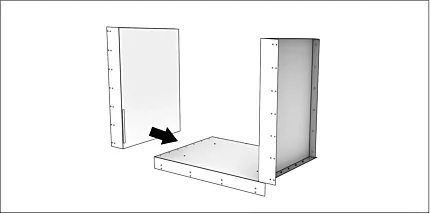
4. Install the top panel.
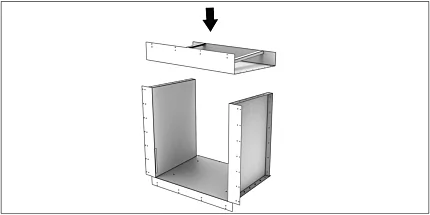
5. Install the back panel.
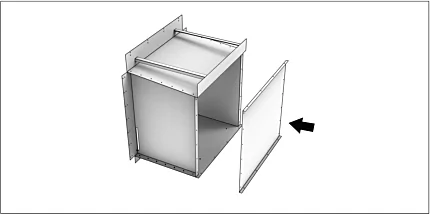
6. Insert the firebox into its designated cavity/built wall area.

7. Secure the appliance to the framework with screws using the existing mounting holes on the appliance flanges. Make sure that the appliance is level before securing it in place.
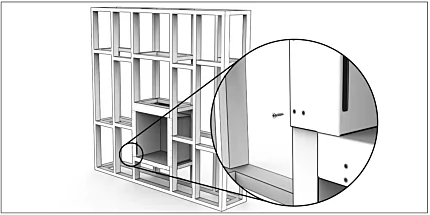
8. Typical drywall isntallation; sheet the wall faces once the Firebox is secured into position.
Complete the construction by finishing the wall paneling around the appliance. (See section on FINISHING INSTRUCTIONS and ensure that you fully understand where non combustible materials must be used.)

9. Insert the grate. Align the four legs of the grate with factory points in the firebox. Secure the grate using the provided screws with a philips head screw driver.
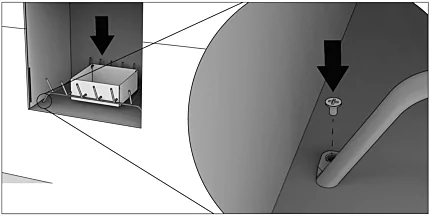
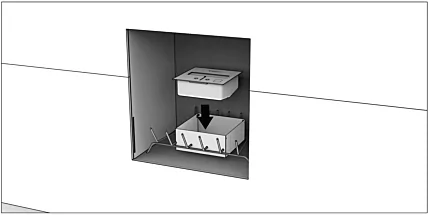
10. Insert the burner into the grate.
11. Carefully insert one side of the glass screen into the slots.
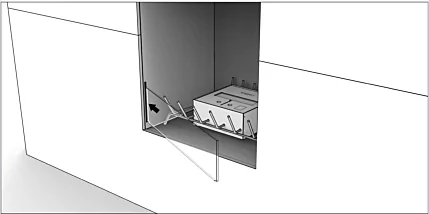
12. Push the glass screen further into the slot enough to align the screen with the opposite end slot.
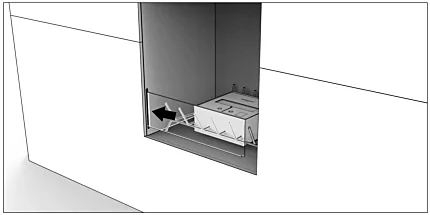
13. Gently slot the glass screen end and push the glass screen down until it falls into location carefully (while holding the glass, check that it is in position by trying to shift the glass left and right).
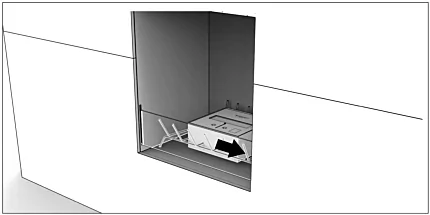
14. Install the ceramic decorative logs around the burner. Do not place on top of the burner.
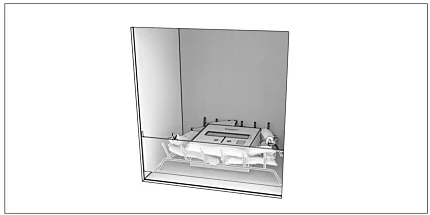
Do not place real timber or any combustible decorative media in the appliance.