Loading image...
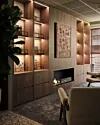
 © Interior: The Unlisted Collective / Builder: The Outfit Group / Client: McGrath Estate Agents / Photo: Dave Wheeler
 Loading image...
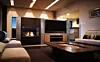

The easiest way to choose a fireplace is to copy a photograph you love. The harder, more useful way is to stand in the space, real or imagined, and ask what the wall with the fire is meant to do.
If it is the natural focal point for one room, a single-sided Flex fireplace often gives you the strongest result. If that wall wants to separate and connect two zones at once, a double-sided opening can make the whole plan feel intentional.
With a ventless bioethanol platform that runs without a flue or gas line, the decision comes back to room geometry, sightlines, and how you want people to live around the flame.
Loading image...
© Interior: The Unlisted Collective / Builder: The Outfit Group / Client: McGrath Estate Agents / Photo: Dave Wheeler Loading image...
A single-sided fireplace presents one viewing face and serves one room or zone. A double-sided fireplace, sometimes called a see-through, two-way, or pass-through fireplace, presents two viewing faces and serves two rooms or two zones at once. That structural difference, one face or two, is the seed every downstream decision grows from: wall geometry, room layout, installation complexity, and how the flame works inside the home's circulation.
Plenty of other configurations exist beyond two faces. Three-sided peninsula installations, bay windows of flame, fully four-sided pavilion designs. They are real, but they sit outside the comparison most buyers are actually weighing. The honest version of the choice almost always comes down to one face or two, and that is the comparison this article runs.
Single-sided | Double-sided | |
|---|---|---|
Viewing faces | One | Two |
Rooms served | One room or zone | Two rooms or two zones |
Visual role | Hero feature wall | Spatial divider, transparent partition |
Best at | Anchoring a focal wall | Connecting two spaces while defining them |
Our Flex platform is built across both configurations, so the comparison here is genuine rather than a vendor pitch dressed as analysis. The Flex SS range covers single-sided installations and the Flex DB range covers double-sided installations. The design language, burner technology, and ventless approach are shared across both, which means the choice between configurations is genuinely an architectural one rather than a forced choice between two different product philosophies.
Before the longer arguments, here is the practical shape of the decision. The table reflects how the two configurations behave inside our Flex platform, not a generic industry average, because product-by-product reality matters more than category folklore.
Factor | Single-sided (Flex SS) | Double-sided (Flex DB) |
|---|---|---|
Viewing faces | 1 | 2 |
Rooms served | 1 | 2 (or 1 large zoned space) |
Wall requirement | Standard insert into a one-way cavity | True two-way cavity, open on both sides |
Structural impact | Low; flush installation against combustibles | Higher; opening through the wall must be engineered |
Installation complexity | Low; insert format only, installable in under an hour | Moderate; cavity construction precedes insert installation |
Cost tier | Lower total project cost | Higher total project cost, driven by structural work |
Heat distribution | Into one space | Across two spaces, divided by glass on each face |
Ideal use case | Feature wall, single room, retrofit, outdoor under overhang | Open-plan division, indoor-outdoor threshold, hospitality |
Ventless option | Yes, across the entire range | Yes, across the entire range |
Outdoor availability | Yes, all sizes, under a protective overhang | Yes, with the same overhang requirement |
A few cells deserve a short note. Product price at equivalent widths is identical between the two configurations, which surprises most buyers; the cost difference shows up later, in the structural work needed to open and frame a two-way cavity. Heat distribution looks like a tie on paper, but in practice double-sided fireplaces are not heating two rooms twice as hard as a single-sided heats one; the same flame is being shared across two faces.
Loading image...
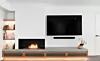

A single-sided fireplace earns its place when the room has a wall that wants to be the visual anchor. In smaller rooms, in cosier rooms, in rooms with a strong directional axis (a long lounge that points at a view, a snug that gathers seating in a horseshoe), the single face is doing more work than two faces would. Two flame faces inside a small room dilute the focal point rather than double it.
Renovation context pushes hard in the same direction. Retrofitting a fireplace into an existing home is fundamentally a question of what you do not have to rebuild. A single-sided insert drops into a standard cavity and works against a normal interior wall, which keeps the project inside one room rather than spreading the dust, the demolition, and the engineering across two. For most retrofits, the single-sided configuration is the one that lets the build finish on time.
Budget honesty matters too. Even when the product price is identical at equivalent widths, the surrounding cost profile is different. A single-sided installation does not need a new structural opening designed, engineered, and signed off. It does not need finishing on two sides of the wall. It does not need a wider hearth detail that reads cleanly from both rooms. None of those costs sit inside the product, which is why this part of the comparison only emerges when you look at the build, not the spec sheet.
Choose single-sided if:
You want a clear hero wall in a single room rather than a partition between two
The room is small to medium, with a strong directional axis or a defined seating arrangement
The installation is a retrofit and structural simplicity matters
The build is outdoor, under an overhang, where a single face into the entertaining area is the point
The budget allocation favours flame size and finish over structural complexity
When the project lines up with most of those points, our single-sided fireplaces collection is the natural starting place, because every model in the range is designed for exactly this kind of focal-wall installation.
Loading image...
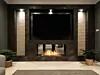

A double-sided fireplace is at its strongest when the wall it sits in wants to be a transparent partition rather than a solid divider. Open-plan living that needs gentle zoning, kitchen-and-dining layouts where a flame defines the threshold without breaking the line of sight, an entry sequence that wants to glimpse the living room through a panel of fire: these are the moments where the second face is not a luxury but the actual reason the fireplace exists.
The architectural record makes this case better than any product copy. The PW Architecture Office project published on Dezeen used a double-sided fireplace to zone the living and dining areas of an open-plan renovation in a 1964 mid-century NSW home, allowing the spaces to read as one volume while still feeling distinct. CLB Architects' Tengoku Residence in Jackson, Wyoming used a double-sided limestone fireplace shared between the living room and a den, and Leroy Street Studio's Louver House in Wainscott deployed a double-sided grey stone fireplace to separate open-plan living from a screened porch. The pattern is consistent: where the brief is about connecting two spaces while still defining them, double-sided does work that single-sided cannot.
The indoor-outdoor threshold is the other strong case. Studio MM Architect's Wass House in New York used a double-sided fireplace with glass doors on both sides bordering a pool courtyard, and projects of that kind explain why the configuration matters in luxury hospitality work too. MG2's treehouses at Skamania Lodge in Washington were designed around an indoor-outdoor fireplace specifically as a guest-experience amenity. When the fireplace is the moment that bridges inside and outside, two faces are the brief.
Trade-offs are real and worth naming. The wall must be a true two-way cavity, open on both sides, and that opening is the part of the project the homeowner pays for outside the product price. The verbatim guidance in our DB installation documentation is direct on the point: a double-sided appliance cannot be inserted into a one-way cavity wall; it must be a two-way cavity with both glass faces free from obstruction, or the wall could overheat. A properly specified two-way cavity, designed from the framing stage, clears this requirement without difficulty, it is a consideration to design for, not a reason to avoid the configuration.
Choose double-sided if:
The room is genuinely two rooms, or one open-plan volume that wants light zoning
The wall that holds the fireplace is intended to be a transparent partition
The fireplace sits at an indoor-outdoor threshold or inside a luxury hospitality scheme
The build is new construction, or a renovation where the structural scope already includes wall modifications
The design language calls for symmetry, sightlines through, and the fire reading from both sides
For projects in that territory, our double-sided fireplaces range is the right place to start the specification conversation.
There is a hidden assumption inside almost every single-sided versus double-sided article online. It is the assumption that a fireplace needs a flue, a chimney chase, a gas line, or a wood-burning structural wall. Once that assumption is in place, every comparison becomes a conversation about how much structural work each configuration adds. The ventless answer rewrites that conversation.
Our Flex range runs on e-NRG bioethanol, fermented from sugarcane or corn, with no smoke, no soot, and no gas connection. The platform is true zero-clearance, which means combustible materials can be built flush to the surround. Flex SS units are insertable into a standard cavity, with no structural wall modification required for installation; the brand claim is under one hour to install. Across the AB and XL burner family that powers the range, every burner carries UL 1370-16 certification and EN 16647 BSI certification, and the appliances are compliant with ACCC recommendations in Australia, where no dedicated AS/NZS standard for bioethanol appliances currently exists.
What ventless removes is more interesting than what it adds:
No flue, chimney, or gas line, which means the placement of the fireplace is no longer dictated by where utilities can run
No structural modification of the wall for single-sided installation, which keeps retrofits clean and fast
No clearance-to-combustibles rebuild, which lets the surround sit flush with the surrounding architecture
No exhaust routing, which means the building envelope stays intact and the fireplace's location is an interior design decision rather than a building-services one
The ventilation guidance our burners ship with exists because bioethanol combustion is real combustion, and real combustion needs airflow. The UL formula is straightforward: 5.7 m³ of air space per 1,000 BTU/h of appliance rating. In a smaller room, a door to an adjacent space or a 25 mm window crack is all the airflow the burner needs.
Independent chamber research (Vicente et al., 2026; Schripp/Fraunhofer WKI, 2014) confirms that adequate ventilation resolves the IAQ consideration, which is why the EN 16647 standard the burners are certified to codifies exactly this guidance.
Outdoor changes the question in two ways. The single-sided answer becomes more compelling whenever the outdoor entertaining area has a defined orientation, because the flame face naturally aligns with the seating, the view, or the entry. The double-sided answer becomes more interesting whenever the fireplace sits at the threshold between inside and outside, because the second face is then doing real architectural work rather than acting as a stylistic flourish.
Every model in our Flex range supports outdoor installation under a protective overhang. The overhead clearance requirement is more generous outdoors (2,000 mm above a standalone burner) than indoors (1,500 mm), and the warranty depends on the firebox sitting under cover; an exposed outdoor installation voids it. That detail matters at the design stage, because it shapes the architecture of the outdoor structure as much as the fireplace shapes the room. For projects where the fireplace is part of an outdoor or transitional scheme, our outdoor fireplaces range is the natural reference point.
Commercial and hospitality contexts are worth a brief note. Luxury hospitality has been leaning into indoor-outdoor fireplaces for the kind of guest experience that lifts a room above the rest of the portfolio, and the design language is more durable than the latest trend cycle suggests. Architectural Digest notes that a built-in focal point such as a fireplace creates order, letting the eye know exactly where to rest. That logic works just as hard in a guest suite as it does in a private home.
By question three, the framework usually points at one configuration without ambiguity. Here is the order that gets there fastest.
Is this fireplace serving one room or two? If one, the single-sided answer is doing more focal work than the double-sided would. If two, ask whether the second room genuinely benefits from the flame, or whether the brief is really about a stylistic preference for the see-through look.
Is the wall meant to be a feature wall or a partition? A feature wall wants a single face. A partition between two spaces wants two faces. The wall's role in the floor plan is usually the most decisive piece of information in the entire comparison.
Is this a new build or a renovation? New builds absorb a two-way cavity into the structural scope without much pain. Renovations, especially in older homes, often find that a one-way cavity is the configuration the existing wall already supports.
Is the installation indoor, outdoor, or at the threshold? Indoor and outdoor installations generally favour single-sided. Threshold installations, where the fireplace bridges inside and outside, often favour double-sided.
How much structural attention can the wall absorb? Single-sided requires almost none. Double-sided requires real structural attention to the wall, the framing, and the finish on both faces. The honest answer here saves a lot of late-stage compromise.
Run the answers through that order, and the configuration usually picks itself. For most homes, the answer lands on single-sided more often than the architectural press would suggest, which is the gap our single-sided ethanol fireplaces collection is built to fill.
The Flex platform exists to take the configuration question out of the technology decision. EcoSmart Fire has been the category reference for ventless bioethanol fireplaces since 2003, and the Flex platform is the product of that accumulated design and engineering experience. Flex SS spans twelve widths, from a compact 378 mm suited to a study alcove all the way to a 4,030 mm continuous-flame installation that defines an entire elevation, so the brief drives the size, not the other way around.
Across the range, Flex SS covers single-sided installations with a constant viewing-area height of 502 mm and a constant viewing-area depth of 340 mm, the full insert depth is 365 mm, which sets the minimum cavity dimension. Flex DB covers double-sided installations across the same width range. Both ranges share the design language, the burner family, and the ventless approach, which means the choice between single-sided and double-sided is genuinely about how the fireplace sits in the home rather than about choosing between two different product worlds.
Burner choices flex with the width. Smaller models use compact burners and serve smaller rooms; larger models use higher-output burners and need correspondingly more room volume to operate within the ventilation guidance. Across the burner family, burn times sit in the eight to fourteen hour window per fill, and heat output scales from 5,800 BTU/h / 2 kW at the smallest end to 30,580 BTU/h (9 kW) at the largest twin-burner configuration. At the low end, that is enough to take the chill off a mid-size living room; at the high end, enough to warm an open-plan space of 230 m³ without supplementary heating. The match between burner and width is engineered, not optional, which keeps the room-volume calculation reliable.
Configuration options inside the range include:
All Flame: a continuous burner running the full width of the viewing area, available across most sizes
Box Left or Box Right: a decorative box on one side with a central burner, available on larger SS models
Two Boxes: decorative boxes on both ends with a central burner, available on the largest models
The configuration question and the size question travel together at the specification stage, which is why our broader Flex single-sided range is best browsed alongside the project's room plan rather than in isolation.
The single-sided versus double-sided question is most often miscast as a style preference. It is really a question about what the wall is doing inside the floor plan. A wall that wants to be the focal anchor of one room wants one face of flame. A wall that wants to be a transparent partition between two spaces, or between inside and outside, wants two. When the answer to that structural question is clear, the configuration follows from it almost automatically.
Ventless changes the calculation in a way the older comparison guides have not quite caught up with. The flue, the chimney, the gas line, the clearance-to-combustibles rebuild: those costs and constraints used to make the configuration decision feel like a structural one. With a ventless platform, the structural burden largely disappears, and the question reverts to being an architectural one. That is the conversation our Flex range is built to support, in both single-sided and double-sided form, across indoor, outdoor, and threshold installations.
The right configuration is the one that lets the room do what it was always trying to do, which is to gather the people inside it around a steady flame. The technology should be invisible. The choice between one face and two is the only part of the decision the room actually feels.
At equivalent widths inside our Flex range, the product price is identical. The Flex 50DB and the Flex 50SS start at the same point. The total project cost differs because a double-sided installation requires a two-way cavity, which means structural framing, engineering, and finishing on both faces of the wall. That work sits outside the product price, but it is real, and budgets should account for it from the first sketch rather than the last invoice.
The configuration choice works best made once, at the design stage, at which point it is a straightforward selection between two well-resolved product lines. The two configurations are separate product selections, and there is no documented conversion path between them. The structural wall behind a single-sided installation is, by definition, a one-way cavity, and converting it would require opening the wall through to the second room, reframing it as a two-way cavity, and replacing the appliance itself. The cleaner answer is to make the configuration decision at the design stage and let the build follow it.
No. A double-sided fireplace runs on the same burner as its single-sided counterpart at equivalent widths. The flame is shared across two faces rather than doubled, which means heat output is divided between the two rooms or zones the fireplace serves. The room-volume guidance our burners ship with applies to the total air space the fireplace is operating inside, not to one room versus the other.