Loading image...

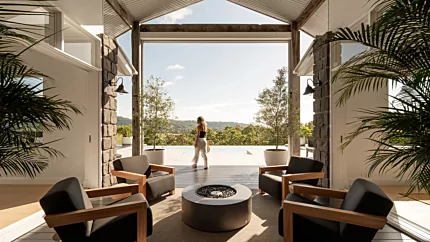
A fire pit in the wrong corner is just an object. The same piece, moved two metres to the spot where every chair in the room already faces it, becomes the thing your eye finds the moment you walk in, the warmth your guests gather around, the reason the evening slows down. Nothing about the fire changed. Only where it sits.
That gap between forgettable and unforgettable is what indoor fire pit placement decides. Across more than 250,000 EcoSmart Fire installations in 75 countries, the placement decision is the one we see homeowners underestimate most. It is the quietest part of the buying process and, in practice, the part that does the most work. Get it right and a freestanding bowl or a low fire table earns its keep every night. Get it wrong and a beautiful flame ends up shoved against a wall nobody looks at, blocked by a sofa, or fighting the room instead of leading it.
The good news is that bioethanol changes the maths. With no flue to chase and no gas line to route, a clean-burning ethanol fire pit can sit almost anywhere the room allows, which means placement becomes a design decision first and a plumbing problem never. So the real question is not can it go here, but should it. Room by room, here is how to find the spot that does the most for the fire and the most for the space around it.
Loading image...
Atmosphere and safety are not two separate conversations. They are the same conversation viewed from two angles, and the best placement satisfies both at once. The spot that gives a flame the clearance it needs is very often the same spot that lets the fire breathe, sits the room's seating in a natural circle, and keeps the flame in your sightline from the doorway. When a fire pit feels right in a room, it is usually because the safe position and the beautiful position turned out to be the same position.
That alignment is easier to find with bioethanol than with any other indoor fire feature. Because the fuel burns without smoke, ash, or a chimney, you are not anchored to an existing flue or an exterior wall, and the fire goes where the design wants it. What you trade for that freedom is a short list of placement principles you keep in your head as you move the piece around the room, and those principles are simple enough to learn once and apply everywhere. Across our indoor fire pits range, the freestanding form factor is what unlocks this flexibility in the first place.
Loading image...
Every good placement, in every room, comes back to three things working together: clearance, ventilation, and the surface underneath. Learn these once and the room-by-room choices that follow become obvious rather than guesswork. The principles below are the why; the exact figures for your specific model and room live in the dedicated installation and ventilation guidance, which is where you should confirm the numbers before you light anything.
Keep the flame away from anything it could reach, both sideways and overhead. Our brand guidance sets a minimum side clearance of 600 mm [23.6 in] from the flame to fixed, stable furniture, and a minimum overhead clearance of 2,000 mm [78.7 in] to moveable items like curtains and hanging plants. These are EcoSmart Fire's own brand-tested principles, developed across more than two decades of installations and backed by independent certification to UL 1370 and EN 16647. Those two measurements quietly explain most placement mistakes. A fire pit tucked under a low pendant light or pressed against the back of a sofa is breaking one of them, and you can usually feel that something is off before you can name it.
A bioethanol flame consumes oxygen and needs a room large enough to replace it. Each burner carries a minimum indoor room size, and matching the burner to the room is the single most important ventilation decision you make. The compact AB3 burner is rated for rooms from 40 m³ [1,413 ft³], while the larger AB8 burner used in Pod 30, and Pod 40 calls for at least 116 m³ [4,097 ft³]. A generous bowl in a sealed box room is a poor match; the same bowl in an open-plan living space is ideal. For the room-size requirements behind each burner class, the indoor fire pits ventilation guidance has the airflow detail.
The floor beneath the flame has to be stable, level, and non-combustible. Our guidance rules out grass, artificial turf, carpet, loose rock, and any uneven surface, and it rules out bathrooms and any small room that cannot meet the ventilation minimum. Weight matters too, especially over timber. A lightweight piece like the Stix sits comfortably on most residential floors, while a heavier bowl belongs on concrete, stone, or a reinforced surface. We will come back to surfaces room by room later, because the floor is often the detail that decides the final spot.
Loading image...
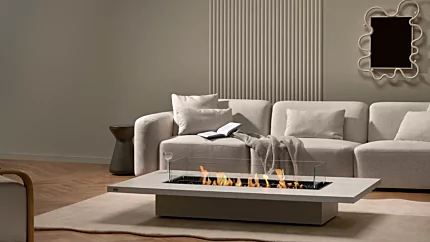
Before you decide where, decide what shape. The form of the fire pit changes how it reads in a room, how close people can sit, and how much floor it asks for. A low bowl pools light downward and suits open plans where you want a gathering point without a visual wall. A fire table doubles as a surface and slots into seating arrangements like furniture. A taller, sculptural piece behaves like an artwork and earns a sightline of its own. A portable tabletop model goes wherever the evening goes.
Form | Best-suited rooms | Placement note |
|---|---|---|
Low fire bowl | Open-plan living, alfresco, generous lounges | Centre it; the low profile keeps sightlines open across the room |
Fire table | Living rooms, dining-adjacent lounges | Treat it as furniture and build the seating around it |
Freestanding sculptural piece | Entrance halls, double-height rooms, reading nooks | Give it a clear sightline; height suits taller ceilings |
Portable tabletop | Studies, small spaces, balconies | Park it on a stable, non-combustible surface and move as needed |
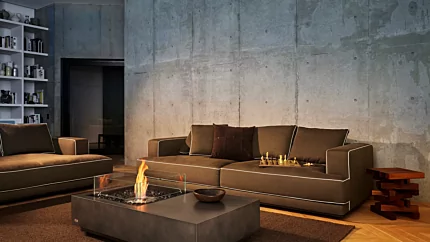
In the living room, the fire pit's job is to be the focal point, and the placement question is really a question about where the room already wants to look. A survey of more than fifty design professionals on Houzz found a fireplace is consistently recommended as a living room standard, valued because it "gives the space ambiance and provides a captivating focal point to arrange furniture around." A fire pit does the same work, with the freedom to sit where a built-in fireplace never could.
You have three broad options, and each sets a different mood. A central island placement, with seating wrapping around it, makes the fire the heart of the room and invites people to face one another across the flame. Against a feature wall, the fire becomes a backdrop and the seating points one way, which suits rooms that already orient toward a particular view or surface. A corner placement is the quiet third option, useful when traffic flow through the room rules out the centre, though a corner asks more of your clearance check because two walls are now in play. For a living room that wants a central island placement, the Pod 40 bowl, one of the low-profile forms in our fire pits range, is the natural fit: its 504 mm [19.8 in] height keeps sightlines open while its 1,000 mm [39.4 in] footprint anchors a generous seating circle.
Best spots in most living rooms:
Centred in the seating cluster, clear of the main walkway, with chairs at a comfortable conversational distance.
Anchoring a feature wall the room already faces, with overhead clearance well above any wall-mounted art or shelving.
Spots to avoid:
Directly beneath a low pendant or chandelier, where overhead clearance fails.
Pressed against the back of a sofa or hard against soft furnishings.
In the doorway threshold or across the room's main traffic line.
Once the fire has its spot, the seating follows it, not the other way around. Houzz's patio measurements offer a useful indoor rule of thumb: a comfortable fire-feature lounge zone wants a clear area of roughly 4.6 by 4.6 m [15 by 15 ft], with seats set back 0.6 to 0.8 m [2 to 2.5 ft] from the edge of the fire. Closer than that and the front row feels the heat too much; further and the circle loses its intimacy. Aim for a loose ring rather than a straight line, so faces meet across the flame instead of all pointing at a screen. One honest tension worth naming: the fire and the television often compete for the same wall, and the most relaxed living rooms tend to pick a winner rather than asking both to share. When the fire wins, conversation does too.
In an open-plan layout, a fire pit earns a second job beyond atmosphere: it draws a soft line between zones. Position it at the seam where the lounge area meets the dining or kitchen space and it signals "this is where you relax" without a single wall going up. The flame becomes a gentle boundary, the kind that defines a room within a room while keeping the openness that made the plan appealing in the first place.
The discipline here is to zone without obstructing. Keep the placement clear of the kitchen work triangle so cooking flow is never interrupted, and keep it off the main path between the dining table and the kitchen so nobody is squeezing past an open flame carrying plates. Among our contemporary fire pits, a low bowl suits this role especially well, because its profile divides the space visually without blocking the long sightlines that make open-plan living feel generous.
A few placement do's for zoning:
Sit the fire at the lounge edge of the open plan, facing the relaxing seats rather than the cooktop.
Keep a clear circulation path on at least two sides so traffic flows around it, not through it.
Mind the ventilation match: open-plan rooms are usually large enough for a generous burner, but confirm the room volume against the burner's minimum before committing.
A bioethanol fire in the bedroom delivers calm ambiance exactly where you want it: low light, a steady flame, the kind of restful atmosphere that turns a bedroom into a retreat. The discipline is to treat it as an evening feature rather than an overnight heater. EcoSmart Fire models carry certifications to UL 1370 and EN 16647, and the guidance those standards carry is the same common-sense rule: enjoy the flame while you are awake and present in the room, and extinguish it before sleep. Recognised authorities on indoor air quality, including ASHRAE, take the same position on unvented combustion appliances in rooms used for sleeping, and major building codes echo it for fuel-burning appliances in sleeping rooms. That is not a restriction on the room; it is the same practice that governs candles and fireplaces everywhere.
With that settled, placement is straightforward. Keep clear of:
Bedding, throws, and anything that drapes or hangs near the floor.
Curtains and blinds, with the overhead clearance respected for any fabric above the flame.
Wardrobes and dressing areas where loose clothing moves close to the fire.
Bedrooms are often smaller and more enclosed than living spaces, so the burner-to-room match deserves extra attention here. A compact piece with a smaller burner suits a bedroom far better than a generous bowl, and the indoor fire pits ventilation guidance is the place to confirm the room meets the minimum before you bring a flame in.
Loading image...
The study is where a fire pit quietly improves the way the room feels to work in. A calm flame in the corner of your eye does something for focus that a blank wall never will. The trick is keeping the fire in your sightline without ever letting it near the parts of a desk that catch and carry flame.
Keep the flame out of the paper zone. Documents, notebooks, and the loose clutter that gathers on a working desk are exactly what you do not want within reach of a fire, so a desk-adjacent surface only works if it is a dedicated, clear surface set apart from where you actually work. More often the better answer is a freestanding piece in a reading nook or a clear corner, positioned so you catch the flame when you look up from the screen rather than across the keyboard. A portable model is genuinely useful here, because the study is the room most likely to share its fire with the living room on a quiet evening, and a piece you can carry follows you from desk to sofa without complaint.
In a small flat, a fire pit cannot be one of several features competing for attention. It has to be the feature, the single statement piece the room is arranged around, which is actually a gift: tight rooms make placement decisions for you. It is why bioethanol fire pits, and EcoSmart Fire in particular, have become the go-to choice for design-led apartment dwellers who want a real flame without a chimney, with no ash, no smoke, and no flue to route.
Placement in a small space is a discipline of subtraction. A tabletop or compact freestanding piece on a stable, non-combustible surface, given its clearance, and left as the room's clear focal point will always read better than a larger piece crammed in.
Do:
Choose a compact form and let it be the one statement the room makes.
Set it on a stable, level, non-combustible surface with clearance on every side.
Match the burner carefully to the room volume, since small rooms hit the ventilation minimum fastest.
Avoid:
Squeezing a large bowl into a room that cannot meet its minimum room size.
Placing it on carpet, a rug, or any of the prohibited surfaces to save floor space.
Burning right up against a balcony door or window dressing.
For most apartments with a standard open-plan layout, a compact freestanding piece comfortably meets the room-size minimum. The Stix, one of the lightweight forms in our fire pits range, weighs 23 kg and is rated for rooms from 40 m³ [1,413 ft³], which makes it an easy fit for the kind of flat where every centimetre is already spoken for.
The most underrated spot for an indoor-style fire pit is the room that is barely indoors at all: the covered patio, the verandah, the pergola, the transition space where the house opens onto the garden. These rooms get the atmosphere of an indoor flame with the easy airflow of the outdoors, and they are exactly where a fire feature extends the usable evening into the cooler months.
Partial enclosure changes the airflow picture in your favour, but it introduces variables a sealed room does not have. Wind and draught are the main ones. A gusty corner of a verandah will pull and flatten a flame in a way that is more nuisance than atmosphere, so favour a sheltered position where a roof or screen breaks the prevailing wind without sealing the space. Weather exposure matters for the surface too: a spot that catches driven rain will weather a surface faster and can leave a slick, unstable footing, which undoes the level, stable surface the fire needs. Position the piece where the cover genuinely protects it. Among our fire pits suited to outdoor use, several models are rated for outdoor use, which makes them the natural fit for these in-between rooms where weather is part of the picture.
Placement considerations for covered spaces:
Choose a sheltered spot the roof or screen actually protects from wind and driven rain.
Confirm the surface stays level and stable when wet, not just when dry.
Treat a semi-enclosed room's airflow as a benefit, but still match the burner to the covered volume rather than assuming "outdoors" means unlimited.
Loading image...


Surface compatibility is the detail most likely to override your first choice of spot, so it is worth settling in one place. The principle is constant: the floor must be non-combustible, level, and able to carry the weight. What changes room to room is which surfaces you are actually working with. The table below is a qualitative guide; confirm the exact requirements for your model in the installation guidance before you commit.
Surface | Suitability | Placement note |
|---|---|---|
Concrete | Excellent | The ideal base; carries weight and is fully non-combustible |
Tile or stone | Excellent | Common in kitchens, bathrooms-excepted, and alfresco; level and stable |
Sealed timber | Use with care | Fine for lighter pieces; verify the floor's load rating for heavier bowls |
Shag Carpet | Not suitable | Prohibited; combustible, and never level enough |
Shag Rugs | Not suitable | Move the shag rug clear of the placement footprint entirely. |
Raised hearth | Excellent | A purpose-built non-combustible plinth solves both surface and sightline at once |
Before you settle on the final spot, in any room, run the piece through this list. If every box is honestly ticked, the placement is sound.
Clearance checked: at least 600 mm [23.6 in] of side clearance to fixed furniture from the flame, confirmed on every side.
Headroom and ventilation adequate: at least 2,000 mm [78.7 in] of overhead clearance to anything moveable, and the room volume meets the burner's minimum room size.
Surface suitable: level, stable, non-combustible, and rated for the weight; never a shag carpet/rug where air flow is inhibited, turf, or uneven ground.
Away from traffic and soft furnishings: clear of the main walkway, doorways, curtains, bedding, and loose fabric.
Focal-point sightline confirmed: the flame is visible from where people enter and gather, not hidden behind furniture.
Form suits the room: the shape and scale of the piece match the room's proportions and ceiling height.
Keep an indoor fire pit out of bathrooms, out of any room too small to meet the burner's minimum room size, and away from sleeping unattended. Within a room, avoid the main traffic path, the area directly beneath low pendants or hanging items, and any position pressed against curtains, bedding, or the back of upholstered furniture. The surface rules out carpet, rugs, turf, loose rock, and uneven ground. The safest spots are level, non-combustible, well ventilated, and clear of anything the flame could reach.
It depends on the carpet. Thick or shag rugs are not suitable because they can block the clearance and airflow needed beneath the fireplace, and may not provide a stable, level base. Low-pile or flat carpet is generally fine, though a non-combustible hearth or plinth is always a good option for added stability and protection. Avoid placing any indoor fire pit directly on a surface that is uneven or that restricts ventilation underneath the unit.
Keep fixed furniture at least 600 mm [23.6 in] from the flame as a minimum, and set seating a little further back than that for comfort. As a guide drawn from fire-feature lounge design, chairs about 0.6 to 0.8 m [2 to 2.5 ft] from the edge of the fire give people warmth without crowding the flame, and a loose circle at that distance reads as far more inviting than a tight straight row.
In a small living room, centre a compact piece as the single focal point and arrange the seating in a loose ring around it, keeping the main walkway clear on at least one side. Choose a form with a low or slim profile so it does not block sightlines across the room, set it on a non-combustible surface, and confirm the room volume meets the burner's minimum before lighting. One well-placed statement piece beats a larger fire squeezed into a corner every time.
Placement is the lever that turns a fire pit from an object in a room into the centre of one. The flame does not change from one corner to the next, but the room does, and the spot that lets the fire breathe, keeps it clear of everything it could reach, and sits it where the seating already wants to gather is the spot where it finally comes alive.
That is why the room-by-room thread and the three governing rules are really one idea. Clearance, ventilation, and surface are not obstacles to the atmosphere you want; they are the conditions that produce it, because the position that satisfies them is almost always the position that reads best. A living room finds its focal point, an open plan finds its soft divide, a small flat finds its statement, and a covered verandah finds another season of use, all from the same short discipline applied with a little care.
Choose the form for the room, run the placement through the checklist, and trust the spot where safe and beautiful turn out to be the same place. The EcoSmart Fire range is built to sit in exactly these spots: compact burners for studies and apartments, generous bowls for open-plan living, and freestanding forms for the rooms that want a statement. When a fire pit sits exactly where the room was always going to look, the room stops feeling like it is waiting for something and simply settles.